
4K vs. 2.5K Dash Cam: Ending the Dilemma
(feat. Sony STARVIS 2)
Part 2: Why 2.5K Still Matters — And How STARVIS 2 Changes Everything
In Part 1, we explored why 4K has become the gold standard for capturing maximum detail on the road.
However, many drivers assume higher resolution always equals better evidence.
In professional dashcam engineering, 2.5K (2560×1440) is often chosen not as a compromise, but for its superior balance of light collection, thermal management, and system reliability.
Today, we’ll explore the engineering logic behind 2.5K and how Sony STARVIS 2 technology elevates both worlds.
The 2.5K Advantage: Engineering for Real-World Reliability
2.5K isn’t a step down from 4K — it’s a different engineering philosophy built around Thermal Efficiency, Processing Power, and Evidence Retention.
1. The Economics of Sensors: Size, Price, and Pixels
Dashcams typically use image sensors that are very similar in physical size. The image sensor referred to here is a semiconductor component, and its price is generally proportional to its physical size. For this reason, most dashcams use an image sensor with a size of approximately 1/2.8″ (about 5.6 mm × 3.1 mm in a 16:9 aspect ratio). However, some lower-cost products use smaller sensors, while higher-end models may use larger, more sensitive, and more expensive sensors.
Most modern dashcams now adopt Sony STARVIS 2 sensors. For example, 4K models typically use the Sony IMX678 (1/1.8″), while 2.5K models commonly use the Sony IMX675 (1/2.8″). The individual pixel size of these two sensors is identical (2.0μm), and therefore their fundamental characteristics can be considered very similar.
The explanation below is based on sensors with the same physical area but different resolutions, and its purpose is to help illustrate that a higher resolution does not necessarily mean better performance.
2. Why “More Pixels” Isn’t Always the Answer
Processing Overhead vs. Real-time Clarity: A 4K sensor has to process 8.3 million pixels, while a 2.5K sensor handles only 3.7 million. Because the 2.5K system has 55% less data to push through the pipeline, the ISP (Image Signal Processor) can dedicate more “brainpower” to each individual pixel. This allows for more aggressive noise reduction and finer edge sharpening in real-time, which is crucial for reading license plates in low-light conditions.
Thermal Efficiency & Constant Reliability: Capturing and compressing 4K video generates massive amounts of heat. In the confined, sun-baked environment of a car windshield, heat is the enemy of electronics. 2.5K systems run significantly cooler, ensuring the camera doesn’t trigger a thermal shutdown during a critical moment or degrade the sensor’s lifespan over years of use.
Storage Longevity (The Evidence Retention Gap): 4K files are enormous. On the same microSD card, a 2.5K system can store roughly twice as many hours of footage. In hit-and-run cases where the damage isn’t discovered immediately, having 48 hours of history instead of 24 can be the difference between finding the culprit and losing the evidence forever.
3. The Sony STARVIS 2 Synergy: Elevating Both Worlds
Whether you choose 4K or 2.5K, Sony STARVIS 2 technology bridges the gap between raw resolution and high-sensitivity night vision. By standardizing a large 2.0μm pixel size across both tiers, it ensures that your choice isn’t between “detail” and “brightness,” but between “density” and “efficiency.”
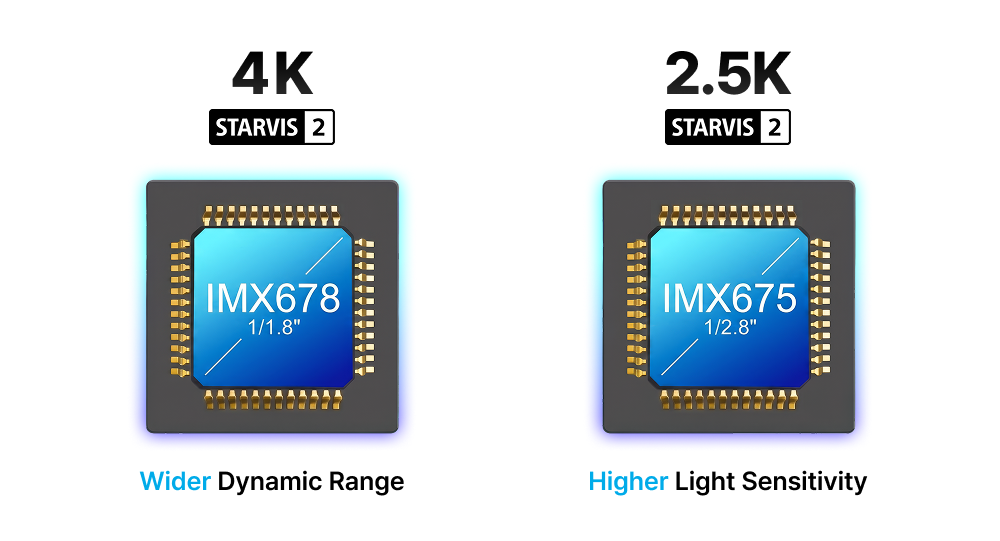
· Supercharged 4K (IMX678): Breaking the Small Pixel Myth Historically, 4K meant sacrificing light for pixels. STARVIS 2 solves the “small pixel” problem of 4K by using a massive 1/1.8″ sensor. This allows the 4K IMX678 to maintain the same 2.0μm pixel cells as its 2.5K counterparts. The result is a high-density 8.3-million-pixel image that remains bright enough for critical nighttime evidence, capturing plates in the dark that previous-generation 4K sensors would have missed.
· Overpowered 2.5K (IMX675): The Low-Light Master The IMX675 takes the already large 2.0μm pixels and packs them into a compact 1/2.8″ sensor. This creates an “Overpowered” 2.5K system that significantly boosts dynamic range. By processing fewer pixels (3.7 million) of the same large size, the system can apply more intensive noise reduction and contrast enhancement. This creates a “Night Vision” effect that often sees more than the human eye can in pitch-black alleys.
Whether you prioritize the Information Density of the 4K IMX678 or the Thermal & Data Efficiency of the 2.5K IMX675, you are getting the industry’s most advanced optical foundation for capturing the truth.
4. Which Resolution Fits Your Life?
| Feature | 4K (IMX678 / 1/1.8″) | 2.5K (IMX675 / 1/2.8″) |
|---|---|---|
| Best For | Highway & High-speed Evidence | City Commuting |
| Sensor Tech | STARVIS 2 (Large 1/1.8″ Sensor) | STARVIS 2 (Compact 1/2.8″ Sensor) |
| Why Buy? | Ultimate Information Density for digital zooming on distant plates. | Maximum Efficiency for low-light clarity and storage retention. |
| Storage | High Bitrate: Packs a massive amount of critical forensic data into every single frame, minimizing compression loss to preserve the finest details. | High Efficiency: Prioritizes “Retention Time,” allowing you to store roughly 2x more footage on the same card. |
Key Takeaway
2.5K is the best choice when thermal resilience, extended storage coverage, and optimized low-light processing are your top priorities.
Conclusion: The Truth is in the Tech
There is no “wrong” choice, only the “right” choice for your needs.
· If you want a forensic powerhouse that can capture license plates clearly even at a distance, go with 4K.
· If you want a cool-running that maximizes your SD card space, 2.5K is your perfect partner.
At Vueroid, we don’t just record video; we engineer the most reliable witness on the road.
Visit our official store to see the STARVIS 2 difference for yourself.