Why Dash Cams Fail to Capture License Plates
and How to Fix It (Part 4) – FPS & Strategic Choice
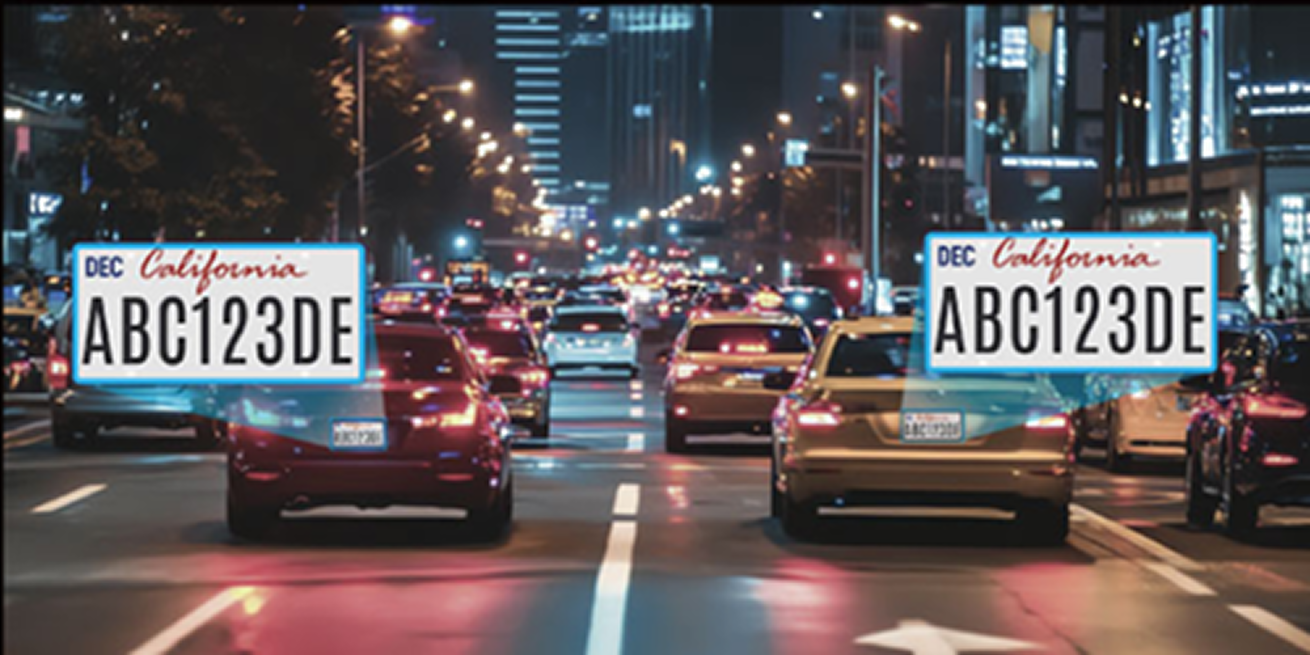
In Part 3, we established why DOL HDR is the superior technology for overcoming the “White-Out” crisis. Now, we turn to the final two factors that determine whether your dash cam captures the exact moment that matters most: frame rate and tuning philosophy.
The FPS Factor: Capturing the “Moment of Truth”
Resolution (4K) provides “spatial” detail, but Frame Rate (FPS) provides “temporal” detail. Accidents happen in milliseconds.
A license plate passes your lens in fractions of a second. That’s where FPS stops being a video quality preference and becomes a forensic variable.
Smoothness vs. Precision
While 30fps is standard, 60fps captures twice as many images per second. This effectively doubles your chances of getting one perfectly clear frame of a license plate as a car flashes past.
Why this matters in practice: At 30fps, a vehicle traveling at 60mph crosses a typical dash cam’s field of view in as few as 3–4 frames. At 60fps, that same moment yields 6–8 frames — doubling the statistical probability that at least one is perfectly sharp and unblurred.
Motion Blur Reduction
High FPS and Shutter Speed work in harmony. Higher FPS allows for a shorter exposure time for each frame without making the video look “choppy.”
What this means technically: Each frame in a 60fps video is exposed for approximately 1/120s or less — roughly half the exposure time of a 30fps frame. Less exposure time per frame means less motion blur per frame, while the increased frame count ensures the video still plays back smoothly and naturally.
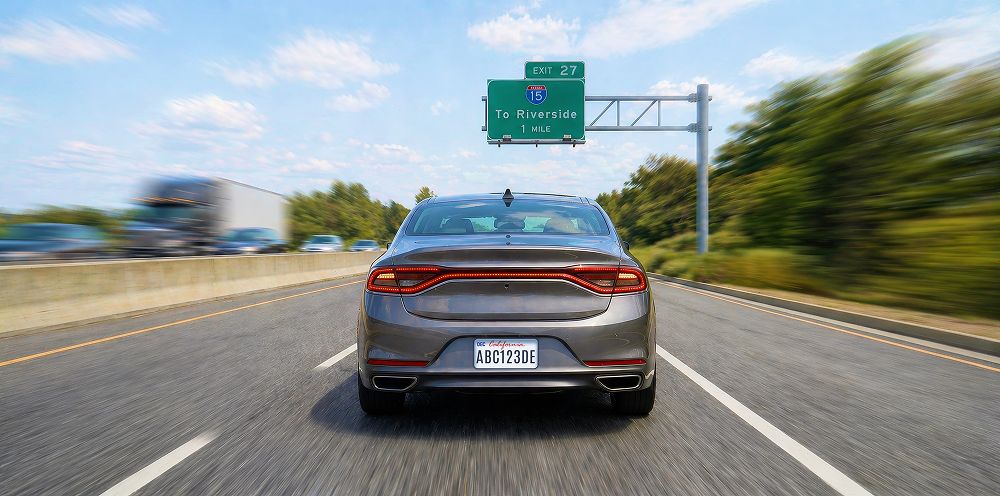 Dash cam footage showing a sharp, clearly readable license plate captured at highway speed using high-speed shutter and 60fps recording
Forensic Value
60fps provides a denser narrative, capturing the exact moment a turn signal was activated or a subtle jerk of the steering wheel that proves liability.
Freezing Time: The Strategic Choice of “License Plate Focused Tuning”
In the field of dash cam engineering, there is no such thing as a “perfect” image that satisfies every requirement simultaneously. Engineers must make a fundamental choice: Should the video look like a cinematic movie, or should it function as a professional forensic tool? The result of this technical deliberation is “License Plate Focused Tuning Mode.” It is a specialized configuration that intentionally sacrifices certain aesthetic elements for the sole purpose of capturing the license plates of moving vehicles.
1) Prioritizing the “Frozen” Moment
While standard dash cams focus on “video smoothness” (making movement look natural to the human eye), License Plate Focused Mode prioritizes shutter speed and frame-by-frame precision.
High-Speed Forensics: To capture a plate even at high cruising speeds, the system utilizes an ultra-fast shutter combined with a dedicated ISP tuning method specifically optimized for license plate clarity. This prevents the image from collapsing or “smearing,” ensuring that each frame remains a sharp piece of evidence.
What “smearing” looks like: When a fast-moving vehicle is captured, license plate details can smear across the frame — blending together and becoming unreadable at speed. License Plate Focused Mode treats each frame as a standalone forensic photograph, not as one continuous unit of video.
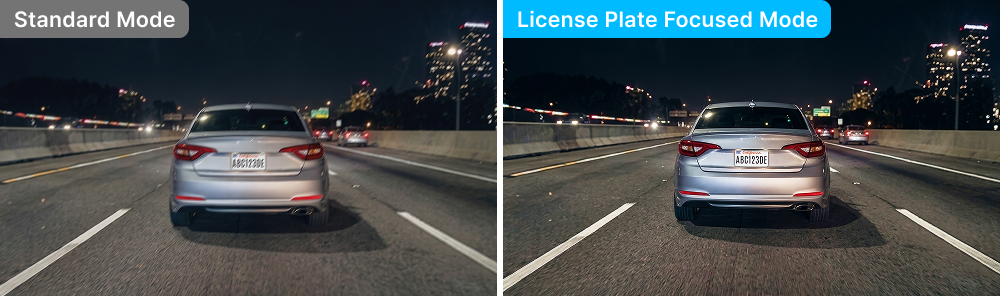 Dash cam night footage comparison — Standard Mode vs License Plate Focused Mode showing sharper,
more readable license plate characters at highway speed
2) The Trade-off for Truth: Evidence over Aesthetics
To eliminate “Ghosting” (the double-image effect) at the critical moment of impact, certain visual “beauties” are partially set aside.
Color vs. Clarity: In this mode, colors may appear different from what you see with the naked eye. This is because the ISP aggressively boosts contrast and enhances character edges to make embossed numbers stand out against the vehicle’s body.
A Strategic Sacrifice: In a legal dispute, the “naturalness” of the sky’s color or the saturation of the grass is irrelevant. Recognizing that the accuracy of a license plate is infinitely more valuable, Vueroid has chosen to prioritize “The Truth” through this specialized tuning, even if it results in less natural color tones.
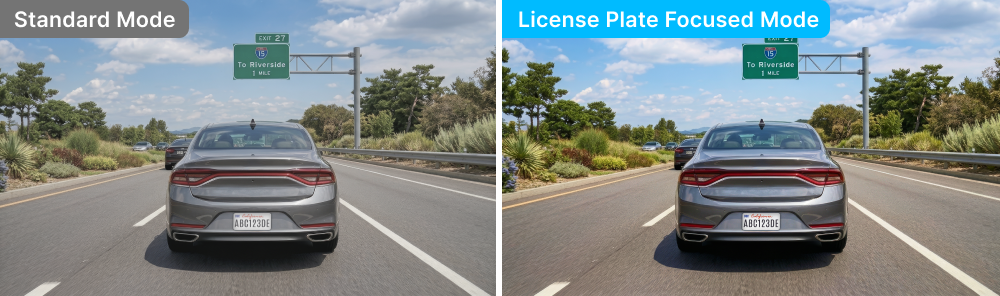 Side-by-side dash cam comparison showing standard mode vs license plate focused tuning mode
— enhanced contrast for sharper, more legible license plate characters
Key Takeaways
- 60fps doubles your forensic coverage — twice as many frames per second means twice the chance of capturing one perfectly clear plate image at the critical moment.
- FPS and shutter speed work together: higher frame rates enable shorter per-frame exposure, reducing motion blur without sacrificing video smoothness.
- License Plate Focused Tuning Mode is not a compromise — it is a deliberate engineering trade-off that sacrifices color naturalism to maximize character legibility.
- Ghosting and smearing are eliminated by combining ultra-fast shutter speed with a dedicated ISP pipeline tuned specifically for license plate clarity.
- In any legal or insurance context, plate accuracy outweighs aesthetic quality — and Vueroid’s tuning is built around that priority.
Next in This Series
In Part 5, we’ll explore how Vueroid’s proprietary Infinite Plate Capture (IPC) and Timed HDR technology bring all five pillars together — automatically adapting to every lighting condition so you never have to choose between daytime clarity and nighttime forensic power.
Read the full series:
→ Part 1: Lens & Optics
→ Part 2: ISP & Sensor
→ Part 3: HDR — DOL HDR vs. Clear HDR