Why Dash Cams Fail to Capture License Plates
and How to Fix It (Part 3) – HDR
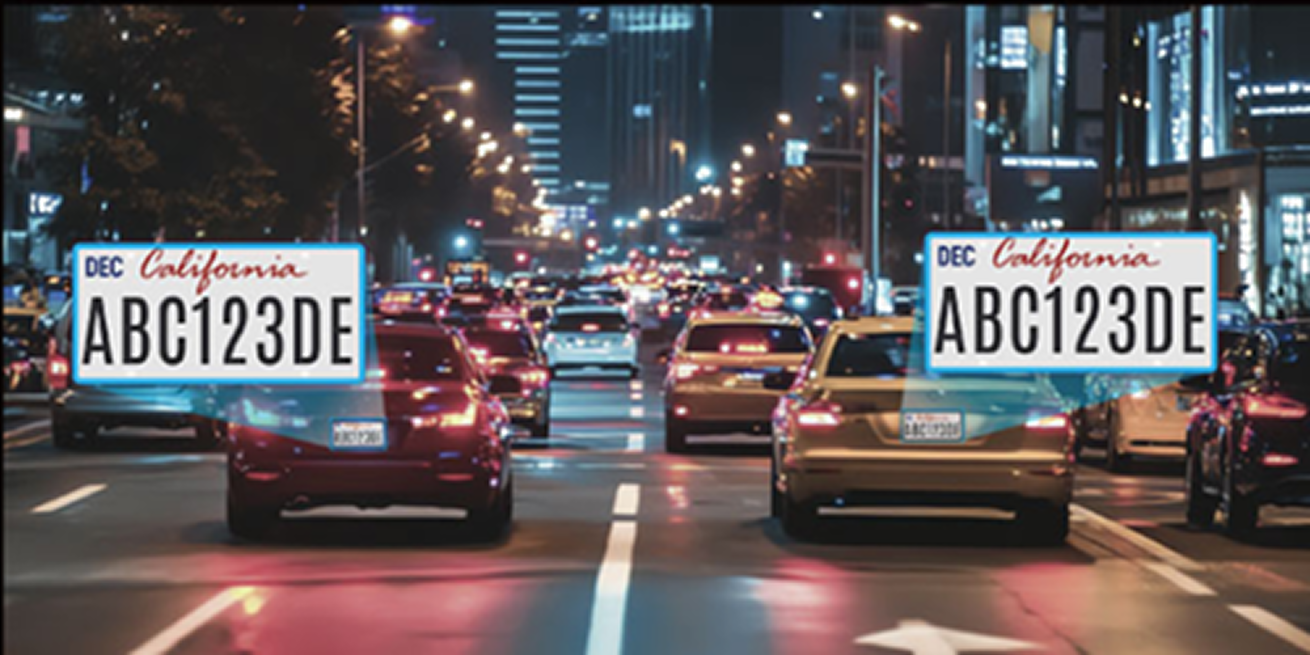
In Part 2, we examined how the ISP transforms raw sensor data into forensically usable footage. But even a perfectly tuned sensor and ISP can be rendered useless by one of the most common real-world scenarios drivers encounter every day: the
“White-Out.”
The “White-Out” Crisis: When Evidence Disappears in a Flash of Light
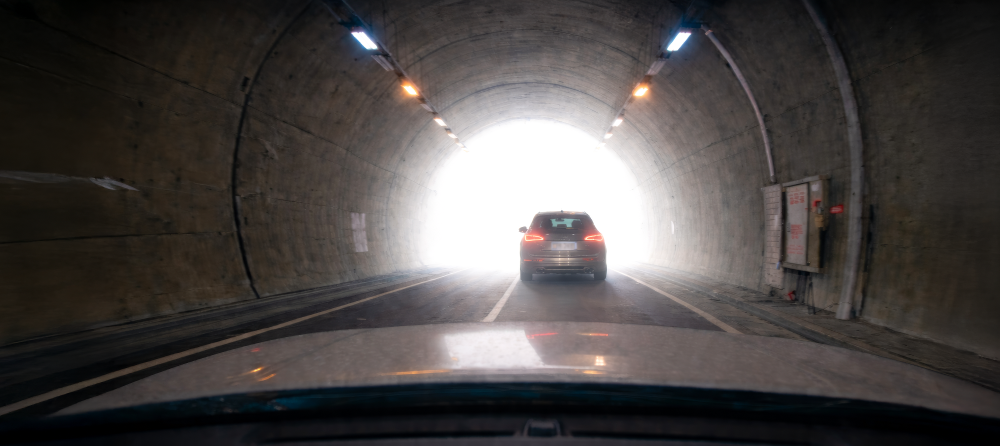
The most common reason dash cam evidence fails is “White-Out”—those moments when a license plate becomes a glowing, featureless white rectangle. This typically occurs at tunnel exits, under direct sunlight, or when facing intense LED headlights. To overcome this, the specific type of HDR (High Dynamic Range) technology used is critical.
The Challenge of Real-Time Exposure Balancing
When exiting a dark tunnel, the sensor is suddenly overwhelmed by a massive influx of photons. If the camera cannot instantaneously balance the dark road and the brightly reflected license plate, the most vital evidence is “erased” by white light.
This is not a resolution problem. A 4K sensor with a flawlessly tuned ISP will still produce a blank white rectangle if the HDR system cannot respond fast enough to the exposure shift. The HDR layer is the final defense between recoverable footage and an evidentiary dead end.
DOL HDR vs. Clear HDR: A Technical Comparison
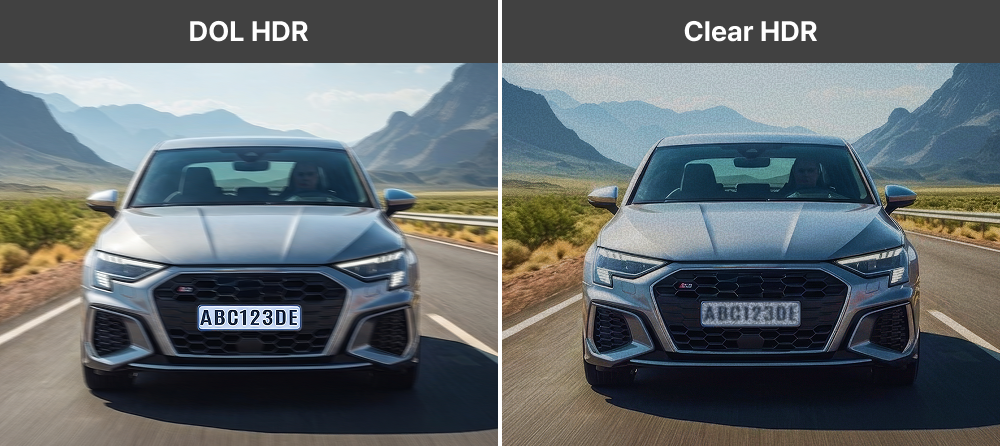
Through extensive laboratory and real-world road tests, we analyzed which HDR technology is truly optimized for license plate recognition. While Sony offers two primary methods, the winner for the driving environment is clear:
Clear HDR (Simultaneous Capture)
This method generates a High-gain and a Low-gain image simultaneously from a single capture. Since both images represent the exact same moment in time, it is theoretically superior for eliminating motion artifacts. However, our nighttime testing revealed a fatal flaw: the excessive noise generated in the High-gain image often blurs the fine details of the license plate.
DOL HDR (Digital Overlap HDR)
This method captures a Short Exposure image followed immediately by a Long Exposure image, then synthesizes them. While a microscopic time gap between frames may exist, our research proved that the advantages of the Short Exposure frame far outweigh the risks of minor artifacts.
Why the Choice Favors DOL HDR
1. The Short-Exposure Advantage
The Short Exposure frame in DOL HDR acts as a secret weapon for moving vehicles. It captures a sharp, “frozen” image of the license plate even at high speeds, while the Long Exposure frame fills in the surrounding dark environment. The result is a composite image where the plate is crisp and the scene is properly exposed—simultaneously.
2. Superior Noise Suppression
Unlike Clear HDR, which suffers from gain-induced noise at night, DOL HDR provides a much cleaner image, ensuring that characters on the plate remain crisp and readable against the vehicle’s body. Because the Short Exposure frame is used specifically for bright regions (including the plate itself), the sensor is never pushed into high-gain territory for that critical region.
3. Real-World Reliability
Our tests consistently showed that in harsh nighttime conditions and during extreme light shifts—such as tunnel exits and oncoming LED headlights—DOL HDR delivers a significantly higher success rate in capturing legible license plates. Where Clear HDR produced washed-out or noise-blurred plates, DOL HDR maintained readable characters frame after frame.
DOL HDR vs. Clear HDR: At a Glance
| Criterion | DOL HDR | Clear HDR |
|---|---|---|
| Capture method | Sequential (Short → Long Exposure) | Simultaneous (High-gain + Low-gain) |
| Motion artifact risk | Minimal (microscopic frame offset) | None (same moment) |
| Nighttime noise level | ✅ Low — plate region captured at native gain | ❌ High — High-gain frame amplifies noise |
| Plate character legibility | ✅ Sharp edge retention | ❌ Noise-blurred at night |
| LED headlight scenario | ✅ Short Exposure clamps highlight | ❌ High-gain noise overwhelms plate signal |
| Verdict for license plate capture | ✅ Optimized | ❌ Not reliable at night |
Key Takeaway
- White-Out is the #1 cause of unusable dash cam evidence—and HDR technology is the primary defense against it.
- Clear HDR, despite its theoretical advantage in motion elimination, introduces fatal high-gain noise that destroys fine plate details at night.
- DOL HDR uses a Short Exposure frame to “freeze” moving plates while the Long Exposure frame handles ambient scene lighting—making it the superior choice for real-world driving.
- Noise suppression is the deciding factor: DOL HDR’s architecture inherently avoids the high-gain noise problem that makes Clear HDR unreliable after dark.
- As established in Parts 1 and 2, all four pillars—lens, sensor, ISP, and HDR—must work together for consistent forensic-grade license plate capture.
Next in This Series
In Part 4, we’ll explore how frame rate determines whether your dash cam captures the “moment of truth”—and why 60fps can be the difference between usable evidence and a motion-blurred miss. In Part 5, we’ll reveal the engineering philosophy behind License Plate Focused Tuning Mode: a deliberate trade-off that prioritizes forensic truth over cinematic aesthetics.
Read the full series:
→ Part 1: Lens
→ Part 2: ISP & Sensor