Why Dash Cams Fail to Capture License Plates
and How to Fix It (Part 2) – ISP & Sensor
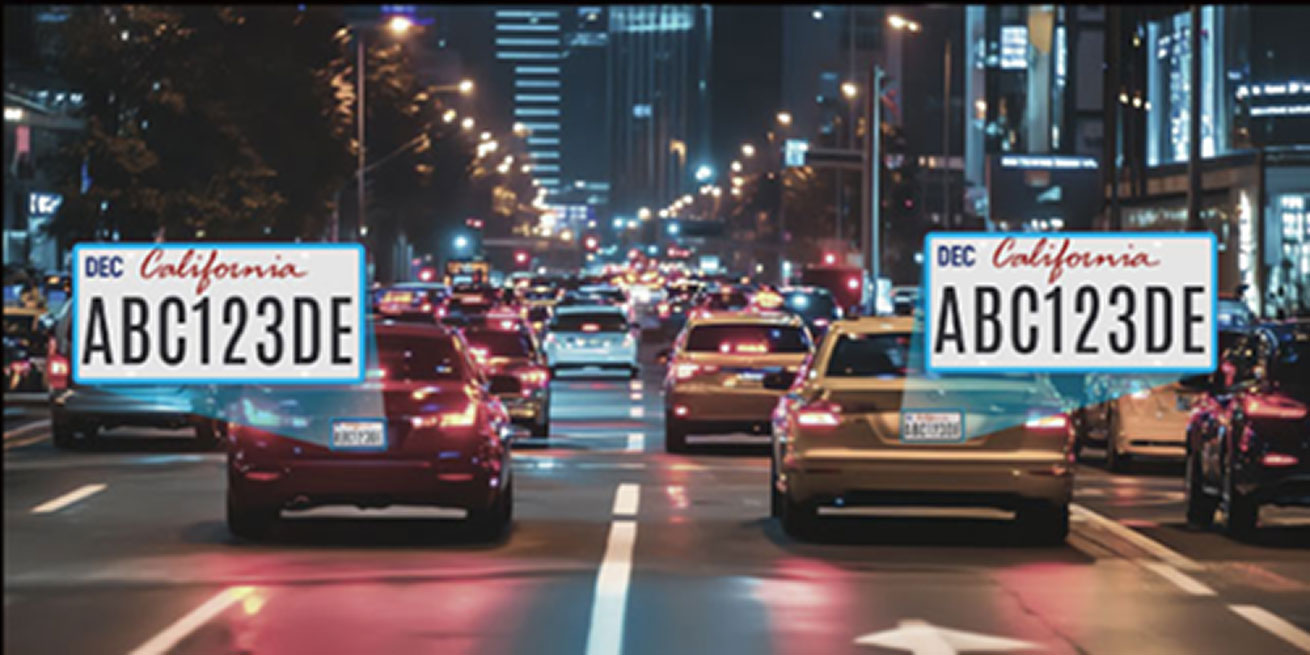
In Part 1, we explored how the lens acts as the optical gateway — determining how much light enters the camera and reaches the sensor. But even with a perfectly engineered lens, a fundamental question remains: can your dash cam actually process that light correctly?
The Core of ISP Tuning: From Raw Light to Forensic Clarity
If the lens is the “eye” and the sensor is the “retina,” then the ISP (Image Signal Processor) is the “brain.”
Raw data from a sensor is often flat, desaturated, and noisy. The ISP is responsible for transforming this “raw light” into a visible, high-definition image. At this stage, tuning must go beyond making the video look “pretty” — it must focus on Forensic Clarity.
What is Forensic Clarity?
It means the image must be usable as evidence, not just as a visual record. Every processing decision — contrast, noise, shutter — is made in service of one goal: keeping license plate characters sharp, distinct, and readable.
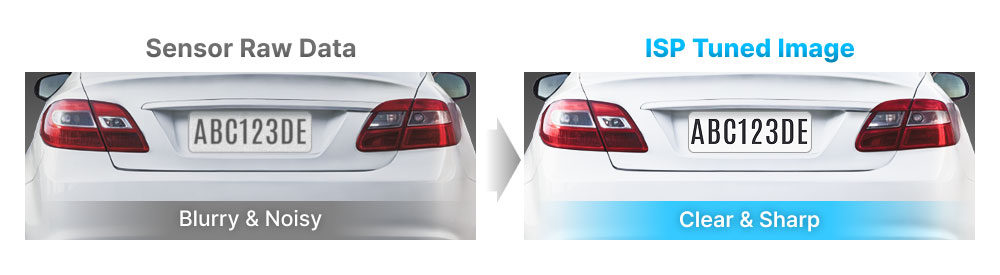
Raw dash cam sensor data vs ISP-tuned output showing license plate clarity improvement
Intelligent Contrast Enhancement: The Reflective Plate Problem
License plates are unique because they are reflective, embossed metallic surfaces. Through precise ISP tuning, the contrast between the embossed characters and the vehicle’s body color can be maximized. This ensures that even on a white car under glaring direct sunlight, the characters on the plate remain distinct and legible.
- The challenge of overexposure: Under direct sunlight or headlights, a reflective plate can wash out completely — characters become indistinguishable from the plate background without active contrast management.
- Local contrast processing: Rather than applying uniform image adjustments, a well-tuned ISP analyzes the plate region specifically — preserving the shadow depth of embossed character edges while controlling highlight clipping on the reflective surface.
- Low-contrast scenarios: A white plate on a white vehicle, or a silver plate under diffuse overcast light, presents a near-zero contrast starting point. ISP tuning is what separates a readable plate from an invisible one in these conditions.
Balanced Noise Reduction: The 4K Pixel Size Trade-Off
High-resolution sensors, such as those in 4K cameras, pack a massive number of pixels into a limited surface area. Because these individual pixels are relatively small, they tend to generate digital noise in low-light conditions. The ISP must maintain a delicate balance: eliminating grainy noise while ensuring that the fine, sharp edges of the plate numbers are not “smudged” or lost.
The over-smoothing problem: Aggressive noise reduction can make dash cam footage appear clean and polished — while simultaneously erasing the fine character edges of a license plate. A plate that looks sharp to the eye can be forensically unreadable if NR has been applied without edge-awareness.
- Too little NR: Grainy, noisy footage — visually distracting and potentially masking plate characters in low light.
- Too much NR: Over-smoothed edges — plate numbers appear smudged, numbers with similar shapes (3/8, 0/D) become indistinguishable.
- Properly tuned NR: Noise is reduced in flat areas (sky, road surface) while high-frequency edge detail — the exact pixels that define plate characters — is preserved at full sharpness.

Dash cam noise reduction comparison showing effect on license plate character sharpnes
Shutter Speed & Exposure Management: Capturing a Frozen Frame
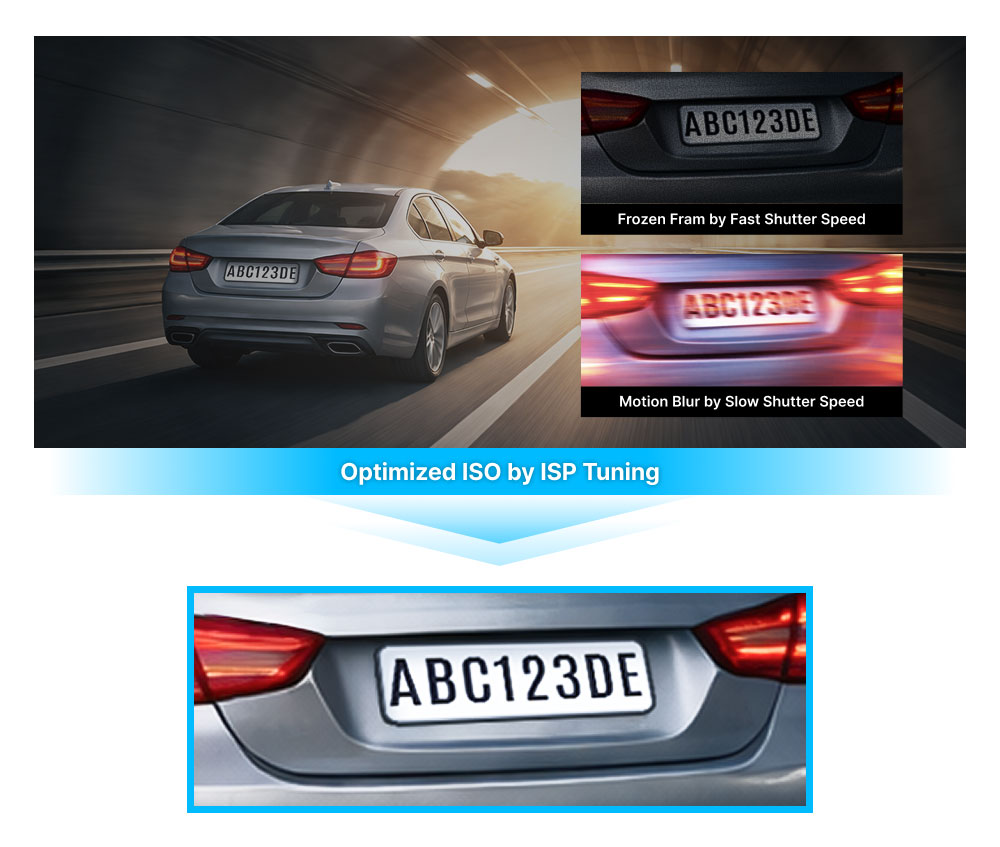
This is perhaps the most critical function of an ISP in a driving environment. The ISP constantly analyzes the scene in real-time to adjust the shutter speed. To capture a moving vehicle as if it were a “frozen frame,” the ISP must maintain a fast shutter speed while simultaneously optimizing the ISO to ensure the image remains bright and clear.
- Why motion blur destroys license plate readability: At even moderate relative speeds, a slightly slow shutter spreads each plate character across multiple pixels — making the plate unreadable regardless of resolution or noise performance.
- The shutter-ISO trade-off: A faster shutter lets in less light. In low-light conditions, the ISP must compensate by raising the ISO — which reintroduces noise. This creates a continuous real-time balancing act that defines the difference between a usable and unusable night recording.
- Real-time scene analysis: The ISP continuously evaluates scene brightness, vehicle motion, and available light — adjusting shutter speed and ISO in combination, frame by frame, to maintain the optimal balance of sharpness and exposure.
Key Takeaway
- The ISP’s role is not to make footage look good — it is to make it forensically usable.
- Reflective, embossed plate surfaces require intelligent local contrast processing to remain legible under glare.
- 4K sensors demand edge-aware noise reduction — aggressive NR destroys the very details it appears to clean up.
- Fast shutter speed is non-negotiable for moving vehicles — the ISP must manage the resulting ISO trade-off in real time.
- As covered in Part 1, even perfect ISP tuning cannot compensate for insufficient light at the lens level — all four pillars must work together.
Next in This Series
In Part 3, we’ll explore how advanced HDR technology prevents “white-out” and preserves license plate details—even in extreme lighting conditions.