
Why Dash Cams Fail to Capture License Plates
and How to Fix It
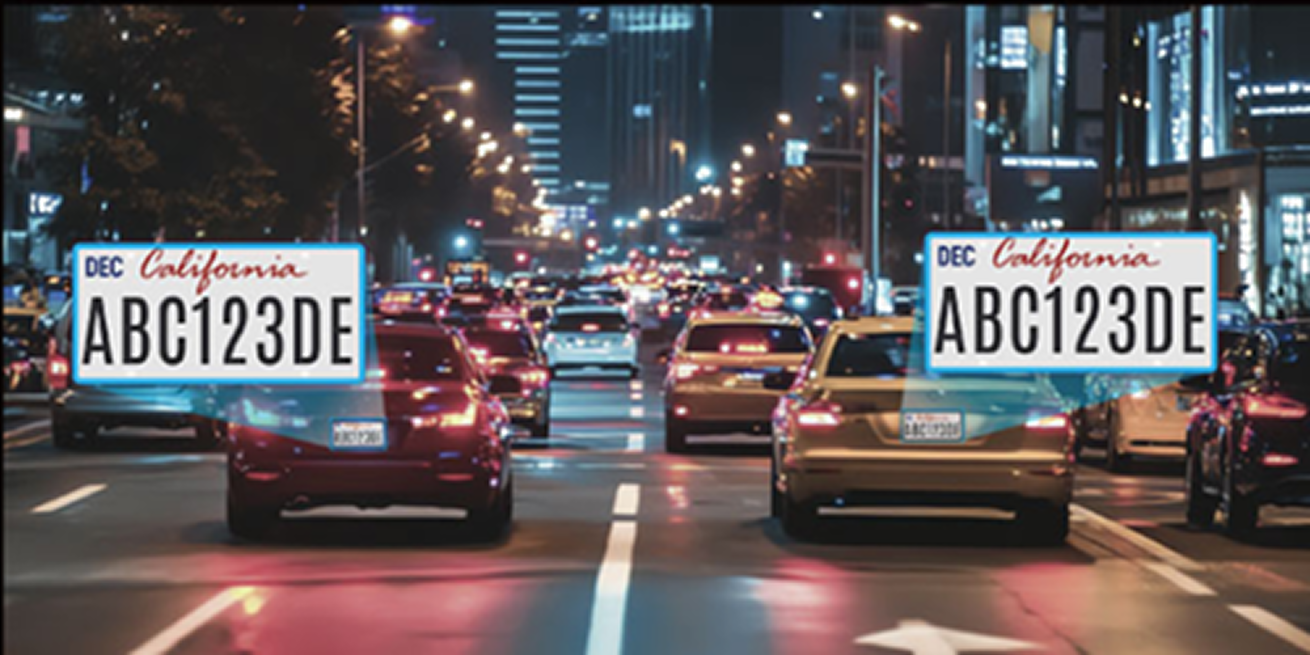
Why can’t my dash cam capture license plates clearly even with a high-definition camera?
For most drivers, a dash cam is an insurance policy.
We expect it to capture one critical detail: a license plate.
But in reality, many dash cam recordings turn out blurry, overexposed, or unreadable at the moment of impact—especially at night.
So why does this happen?
Because identifying a fast-moving reflective object such as a license plate under changing light conditions is one of the hardest tasks in optics.
And contrary to popular belief, resolution alone is not enough.
What Actually Matters in Dash Cam License Plate Capture
To choose a dash cam that works when it matters most, you need to understand the four key pillars of image capture:
- Lens (Optics)
- Sensor
- Image Processing (ISP)
- Frame Management
In this article, we focus on the most fundamental one: the lens.
The Optical Gate: Why the Lens and F-Number Are Make or Break
In dash cam license plate recognition, the F-number (aperture) is just as critical as resolution.
It is the physical foundation that determines whether your camera captures a clear ID or a grainy blur.
Why a Low F-Number Is Essential for Capturing License Plates
To capture a license plate clearly, a dash cam needs two things:
contrast and speed.
However, most dash cams struggle—especially at night—because not enough light reaches the sensor.
Why Dash Cam License Plate Capture Fails at Night
At night, a dash cam must use a fast shutter speed to freeze a moving vehicle and avoid motion blur.
But if the F-number is too high (e.g., F2.4):
- Less light enters the sensor
- The camera compensates by increasing ISO
- This results in digital noise
- License plates become blurry or unreadable
👉 This is one of the main reasons dash cam footage becomes blurry at night, even with a high-definition dash cam.
How a Low F-Number (F1.6) Improves Dash Cam License Plate Recognition
A wide aperture (e.g., F1.6) allows significantly more light to enter the lens.
This enables:
- Maintaining faster shutter speeds even in low-light conditions
- Reducing motion blur when capturing moving vehicles
- Minimizing ISO-related noise
- Achieving clearer and more readable license plate images
Think of it as a wider optical gate that provides enough light for the camera to accurately capture fast-moving objects—even at night.
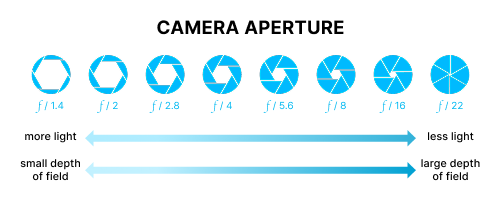
Low F-Number vs. Depth of Field: The Hidden Trade-Off in Dash Cam Performance
Is choosing a low F-number (aperture) enough to capture license plates clearly?
The answer is no. There is a critical trade-off:
the lower the F-number, the shallower the depth of field (the area that remains in focus).
This means that while a wide aperture like F1.6 improves low-light performance, it can also make parts of the image—especially near the edges—appear out of focus.
How Premium Dash Cams Maintain Focus with a Low F-Number
Unlike low-end cameras that rely on all-plastic lenses—which can warp and drift out of focus under windshield heat—premium systems use a strategic hybrid stack.
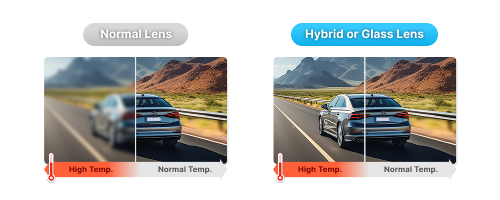
1. Thermal Focus Stability (Hybrid Lens Design)
By combining:
- High-grade glass elements for thermal stability
- Specialized optical polymers for precision shaping
premium lens systems can provide:
- More stable focus even in high temperatures
- Consistent image clarity over time
2. Uniform Edge-to-Edge Sharpness
A low F-number (wide aperture) can introduce edge softness, where the center is sharp but the edges are blurry.
To solve this, premium dash cams incorporate precision-molded aspherical lenses.
These elements:
- Correct the path of incoming light more precisely
- Maintain sharpness across the entire frame
👉 This helps ensure that even a license plate near the edge of the frame remains readable.
3. Precision Manufacturing: Why Active Alignment Matters
Even the most advanced software or ISP (Image Signal Processor) algorithms cannot restore detail if an image is out of focus at the hardware level.
True image clarity starts with precise lens-to-sensor alignment.
This is especially critical for dash cams, where capturing readable license plates depends on fine-detail accuracy.
The Role of Active Alignment in Dash Cameras
Active Alignment enables micron-level precision between the lens and sensor while the camera is actively capturing a live feed.
This process helps ensure:
- Light is accurately focused onto the sensor
- Each pixel receives correct image data
- Overall image sharpness is maximized
Maximizing ISP Potential
Only when perfectly focused raw data is delivered can the ISP perform at its full potential.
Without this physical precision, the ISP lacks the detail needed to sharpen the edges of license plates or enhance contrast to a forensic level.
Key Takeaway
A dash cam’s ability to capture license plates is not determined by resolution alone.
To achieve clear, readable results—especially at night—you need:
- A low F-number for more light
- Optimized lens design for consistent focus
- Precision manufacturing for accurate alignment
Next in This Series
In Part 2, we’ll explore how the sensor and ISP (Image Signal Processor) transform raw light into readable images—and why even a great lens is not enough without intelligent tuning.