
What Does a CPL Filter Actually Do
for Dash Cam Footage?
CPL filters have become a common accessory, either included with dash cams or sold separately. They are often introduced as a simple way to reduce glare and improve image clarity, but their actual function is more specific than that.
A CPL filter does not increase a dash cam’s resolution or improve image quality in every recording environment. Its primary role is to control certain types of reflected light—particularly reflections from the dashboard and windshield that can obstruct the camera’s view of the road.
So, how does a CPL filter work, what difference can it make to actual footage, and is it worth using?
1. What Is a CPL Filter?
CPL stands for Circular Polarizing Filter. It is an optical filter fitted in front of a camera lens to control the direction of light entering the camera.
2. How Does a CPL Filter Work?
Light normally travels while vibrating in multiple directions. When it reflects off a non-metallic surface such as glass, water, paint, or plastic, some of the light becomes polarized, meaning that it becomes aligned in a particular direction.
A CPL filter contains a polarizing layer that selectively allows light traveling in certain directions to pass through while limiting light traveling in others. Rotating the filter changes the direction of light it allows through, enabling it to be adjusted for the camera and its installation environment.
In a dash cam, this optical process takes place before the light reaches the lens and image sensor. In other words, rather than correcting the footage after it has been recorded, a CPL filter optically controls the light reaching the sensor at the point of capture.
3. Why Can a CPL Filter Be Important?
Unlike a conventional camera, a dash cam records the road through a windshield. This creates an additional optical surface between the camera and the road.
When strong sunlight illuminates the dashboard, reflections of the dashboard and other parts of the vehicle’s interior may appear on the windshield and overlap with the view of the road.
These reflections do not reduce the camera’s actual resolution. However, they can obscure road details that the camera would otherwise be able to capture clearly. Improving dash cam footage is therefore not always a matter of using a higher-resolution sensor. In certain conditions, controlling the light entering the lens can be just as important.
In addition to controlling reflections, a CPL filter can also help improve contrast and color saturation in bright daytime footage. It can make blue skies appear deeper and more vivid while increasing the contrast between white clouds and the sky, resulting in a more vibrant overall scene.
4. When Is a CPL Filter Most Effective?
A CPL filter is generally most effective in the following conditions:
- When strong sunlight illuminates the dashboard
- When the dashboard is light-colored or glossy and produces strong reflections
- When reflections of the vehicle’s interior are clearly visible on the windshield
- When reflected light from wet roads, glass, or vehicle surfaces obstructs the camera’s view
- When the dash cam is used primarily in bright daytime conditions
The effectiveness of a CPL filter can vary depending on the direction of sunlight, the angle of the windshield, the dashboard material, the camera’s installation position, and the type of window film used.
Reduced Light Transmission
The most significant drawback to consider when using a CPL filter is the reduction in the amount of light reaching the camera.
When unpolarized light passes through an ideal polarizing filter, only one polarization component is transmitted. In theory, the maximum amount of light that can pass through the filter is therefore limited to approximately 50%. With an actual CPL filter, additional losses may occur due to the polarizing material, optical layers, and coatings, meaning that real-world light transmission may be even lower.
In bright daytime conditions with plenty of ambient light, this reduction may not cause a significant issue. At night or in low-light environments, however, less light reaches the image sensor. The camera may compensate by increasing the exposure time or sensor gain.
Depending on the camera system, this can increase image noise, cause motion blur, or reduce the amount of visible detail.
A CPL filter also cannot eliminate every type of glare. Light entering the lens directly from headlights or streetlights may not be polarized in the same way as light reflected from glass, water, or glossy surfaces, so it may remain visible in the footage.
Interaction with Window Tinting
Window tinting and CPL filters do not serve the same purpose. Window tinting primarily reduces the amount of visible light and solar energy passing through the glass, while a CPL filter controls light polarized in specific directions.
A CPL filter may therefore still be effective in a tinted vehicle if reflections from the dashboard or windshield remain visible. However, dark tinting already limits the amount of light reaching the camera. Adding a CPL filter reduces it further, which may negatively affect nighttime or low-light recording.
The results can become more complex depending on the construction of the window film. Automotive films may use dyed, ceramic, metallic, or multilayer structures, and some films can alter the polarization characteristics of the light passing through the windshield.
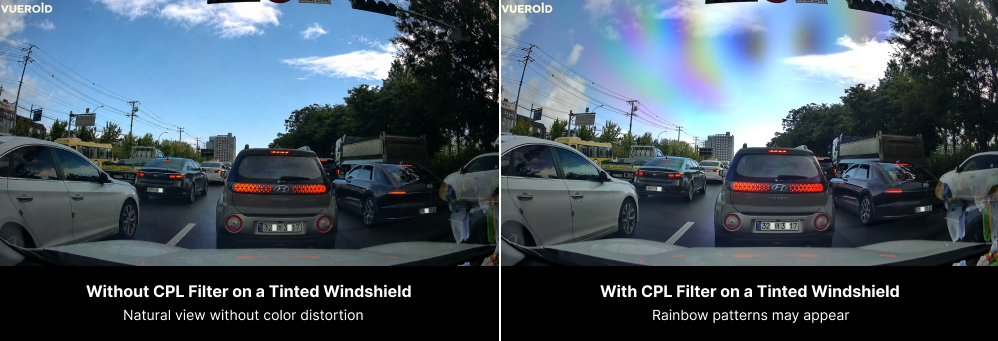
When these optical characteristics interact with a CPL filter, the following effects may occur:
- Uneven color reproduction
- Rainbow-like patterns
- Noticeable color banding
- Partially darkened areas
- A further significant reduction in light transmission
The severity of these effects can vary depending on the type of window film, the angle at which the camera faces the glass, its installation position, and the orientation of the CPL filter.
In severe cases, the CPL filter and window film may restrict similarly oriented light at the same time, causing certain parts of the image to become noticeably darker.
However, these issues do not occur with every type of window tint. For vehicles with particularly dark or multilayer window film, the most reliable approach is to compare footage recorded with and without the CPL filter in both daytime and nighttime conditions.
Conclusion
A CPL filter does not provide the same results in every vehicle. It offers the greatest value when reflections on the windshield interfere with the camera’s view of the road and there is sufficient ambient light.
For vehicles with dark window tinting or for drivers who frequently travel at night, the additional reduction in light caused by a CPL filter should be considered. In these conditions, directly comparing footage recorded with and without the filter is the most reliable way to determine whether the benefits outweigh the disadvantages.
The VUEROID S1 Series supports a dedicated CPL filter for drivers who want additional optical control in bright or reflection-heavy environments. Rather than being an essential accessory for every vehicle, a CPL filter is a practical option that can be selected according to the vehicle’s window tint and the driver’s typical driving and recording conditions.